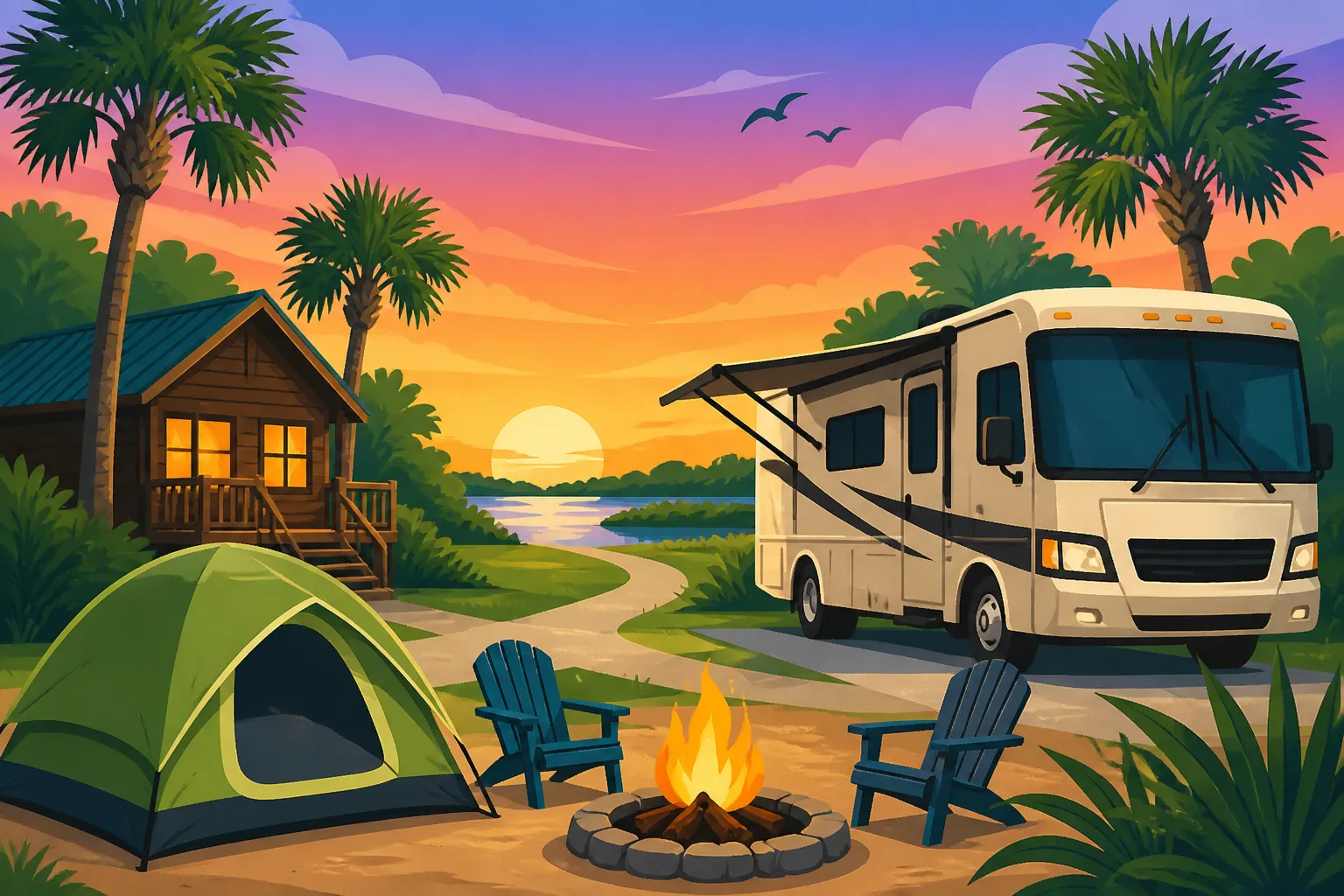
Overnight Stays in Florida State Parks: Campsites, Cabins and More
Florida state parks offer several kinds of overnight stays, but choosing the right one can be harder than it looks. A tent site, an RV site, a boat-in campsite and a cabin call for different planning. This guide explains how to compare the options, what to check before reserving, and how to avoid relying on assumptions about a particular park.
Overnight options in Florida State Parks
The Florida Legislature says reservations may be made for cabins and campsites, including sites for RV, tent, boat, and equestrian camping. That range gives travelers useful choices, but it does not mean every park has every kind of accommodation. Start with the park you want to visit, then check which overnight options it actually lists.
A useful way to think about the options is to separate the type of shelter from the way you reach or use the site. A cabin provides a different kind of stay from a tent campsite. Campsites, in turn, may be set up for different camping styles, including RV, tent, boat, or equestrian camping. A site intended for one style is not automatically a good match for another.
| Overnight option | Often suits travelers who | Confirm before reserving |
|---|---|---|
| Cabin | Want a roofed stay rather than a campsite | What the cabin includes, what to bring, and whether it suits your group |
| RV campsite | Are bringing a motorhome, trailer, or other recreational vehicle | Site dimensions, hookups, parking, and any equipment restrictions in the listing |
| Tent campsite | Plan to sleep in a tent | The surface and layout, vehicle access, and whether the listing permits your setup |
| Boat campsite | Are arriving by water or planning a paddle-in stay | Access, route, landing details, and what the site listing says about the trip |
| Equestrian campsite | Are traveling with horses | Horse-related facilities, site requirements, and park-specific conditions |
The table is a starting point, not a substitute for the individual park description. The listing for the particular accommodation is where you can check what that location offers and whether its conditions fit your plans.
If a cabin is appealing, consider what you need from it rather than assuming that all cabins have the same furnishings or facilities. A roofed structure may still require you to bring bedding, cooking supplies, or other items. The park’s listing should guide that decision. For a closer look at the range of accommodation styles, see Rustic or Modern? Florida State Park Cabin Styles Explained and What Comes With a Florida State Park Cabin or Yurt?.
For a campsite, start with the equipment you will actually bring. A tent camper looking at an RV listing, or an RV traveler selecting a tent-only site, may find that the reservation does not match the setup. Compare campsite categories before looking at dates. Tent Site or RV Site? Picking a Campsite Type in Florida State Parks explains what to consider when choosing between those options.
Boat and equestrian camping require a different kind of fit check. With boat camping, the accommodation is only part of the plan: access to the site and the route to reach it matter too. For equestrian camping, confirm that the listing is intended for that use and check its details before making plans around horse facilities. The relevant topic pages, Paddle-In and Boat Campsites at Florida State Parks and Equestrian Campsites in Florida State Parks: Camping With Horses, can help you focus your questions.
Choose by trip style, not just by park name
It is tempting to pick a well-known park first and work out the overnight details later. That can make the search harder, especially if the park’s available accommodation does not fit the way you want to travel. A better approach is to narrow down what you need, then compare parks that offer a suitable option.
Begin with your preferred sleeping arrangement. If you want a cabin, look for a park that lists one and check its description. If you are camping in an RV, search for a campsite that identifies itself as suitable for your vehicle and setup. If you are tent camping, make sure the site description supports that use. For water-based or horse-centered trips, check for the matching campsite category rather than assuming a standard campsite will work.
Then think through your trip as a whole:
- How do you want to arrive? A vehicle-based campsite, a boat-access site, and an equestrian site involve different equipment and logistics.
- What do you need at the overnight spot? Decide which facilities or features are essential and which are optional.
- Who is traveling? Consider the group’s sleeping arrangements, mobility needs, and comfort with the proposed setup.
- What will you do during the day? A stay can be shaped by paddling, riding, hiking, swimming, or simply spending time at camp. Check that the overnight option supports the kind of visit you have in mind.
- What are you prepared to bring? A cabin and a self-contained camping setup call for different packing decisions.
- How much uncertainty is acceptable? If a particular amenity is essential, verify it in the current listing before you commit.
Some decisions are practical rather than picturesque. A campsite may look attractive on a map but still be unsuitable if it cannot accommodate your vehicle, tent, or other gear. A cabin may be in the right part of the park but not have the features your group expects. Make a short list of requirements, then compare listings against that list rather than relying on a broad description of the park.
Region and trip style can help narrow the search as well. A route built around boating or horseback riding may need different overnight options from a trip focused on a comfortable cabin stay. If you are open to more than one destination, Choosing a Florida State Park Campground by Trip Style and Region can help organize that comparison. If you are visiting from outside Florida, Visiting Florida State Parks From Out of State: What Differs for You covers questions that may affect your planning.
Do not treat a park’s general amenities as proof that a particular overnight unit has the same amenities. A facility elsewhere in the park may not be part of your cabin or campsite, may not be close to it, or may have conditions that matter to your plans. Check the specific accommodation description for the details that affect your stay.
Check the listing before you commit
A reservation is only useful if the accommodation matches the trip you intend to take. Read the listing as if you were checking a gear checklist: identify what it confirms, what it leaves unclear, and what you need to ask the park or verify through its official information.
For a campsite, look closely at the site type and any stated limits or dimensions. If you are bringing a recreational vehicle, check the length and layout details against your full setup, not just the vehicle body. A tow vehicle, slide-outs, awnings, and other equipment can affect whether the space is workable. A tent camper should check the description for whether the site suits a tent and consider how the listed layout will fit the group and gear.
For cabins, focus on the specific unit rather than the word “cabin.” Check what furnishings and equipment are included, what sleeping arrangements are described, and what the listing says to bring. If a particular feature is important—such as a cooking arrangement, bathroom, or accessibility feature—look for confirmation in the official description. Do not infer that a detail applies just because it was true at another park or another cabin.
For boat and equestrian sites, the approach to the site is part of the accommodation decision. A boat site can involve a water route and equipment you would not need at a drive-up campsite. An equestrian site needs to suit the riders, horses, and gear in your party. Check the listing for access details and conditions, and contact the park through its official channels if the information you need is not clear.
Before booking, compare these details:
- Accommodation category: Does the listing name the type of site or unit you need?
- Capacity and layout: Does the description fit your group and the way you plan to sleep?
- Equipment fit: Are your vehicle, tent, boat, or horse-related needs covered by the listing?
- Facilities: Are the features you depend on explicitly described?
- Access: Can you reach the site with your planned vehicle or equipment?
- Park-specific conditions: Are there rules or restrictions in the listing that could change your plans?
- Reservation details: Do the dates and selected accommodation match what you intended to reserve?
The listing is also the place to check questions that cannot safely be answered with a statewide assumption. Details such as site layout, equipment limits, check-in instructions, and what is provided can differ by location or by accommodation. For questions about arrival and departure, use Finding Check-In and Checkout Details for a Florida State Park Site rather than guessing from a past visit.
If the listing is brief, treat missing information as a question, not as permission to assume. Use the park’s official website to find current contact details and ask about the specific site or unit. Be ready to describe your setup clearly: the kind of vehicle, tent, boat, or horse-related equipment you plan to bring, and the feature you need confirmed. A focused question is more likely to get a useful answer than a general request for “a good campsite.”
Match the reservation to your group and gear
The right overnight option has to work for everyone in the travel party, not just for the person making the reservation. Before choosing a site, talk through sleeping arrangements, arrival plans, equipment, and any needs that could affect comfort or access.
For families or mixed-age groups, consider whether a single cabin or campsite layout will suit the way everyone sleeps and spends time at camp. A site can fit the reservation description but still feel cramped if the group brings more gear than expected. If you are considering a larger party, check the site’s stated capacity and the park’s conditions rather than relying on what another group managed at a different location.
For friends traveling together, clarify who is bringing what. One person may be responsible for the tent, another for cooking equipment, and someone else for transportation. That coordination is especially important when a group is using more than one site or when different people are arriving separately. The details in How Many People Can Share a Florida State Park Campsite? and Too Many Campers for One Site? Splitting a Group Across Sites can help you plan the reservation around the group rather than trying to improvise after arrival.
Accessibility needs deserve an early check. A site label alone may not tell you whether the route, surface, facilities, or layout will work for a particular person. Look for information about the specific campsite or cabin, then ask the park about any detail that remains uncertain. Accessible Campsites in Florida: How to Find and Reserve One and Route, Surface and Restrooms: Questions for an Accessible Site offer a more focused way to evaluate those questions.
Pets and other special needs should also be checked at the individual park and accommodation level. Do not assume that a park’s general pet policy answers whether a particular cabin or campsite is suitable for your animal. Likewise, do not assume that an accommodation has space or facilities for a special piece of equipment unless the listing says so. For pet-related planning, the site’s rules and the relevant details in How to Tell if a Florida State Park Cabin Is Pet-Friendly can help you identify what to verify.
One practical technique is to create a “must have” and “nice to have” list. A must-have could be a site that accommodates your vehicle, a specific sleeping arrangement, or confirmed access for your planned mode of travel. A nice-to-have might be a preferred view or a particular location within the park. This makes it easier to compare options honestly. If the listing does not confirm a must-have, do not treat it as satisfied just because the rest of the site looks appealing.
When more than one vehicle is part of the plan, check the listing’s parking information and any applicable conditions. A reservation for a campsite does not by itself tell you how many vehicles can be accommodated or where they can park. The same principle applies to extra visitors: clarify the park’s requirements rather than assuming that visitors can use the overnight site without limits. See How Many Vehicles Can Park at a Florida State Park Campsite? and Friends Visiting Your Florida State Park Campsite for the Day for related planning questions.
Plan the booking and the cost separately
Choosing where to stay and understanding the cost are related, but they are not the same task. Start by identifying the exact park, accommodation type, and dates you want. Then review the reservation details and current charges shown through the official reservation process. Do not rely on an old screenshot, a past trip, or another camper’s total to estimate what your reservation will cost.
The total can depend on the accommodation and the details of the reservation. Check which charges are shown, whether the displayed amount applies to the full stay or a particular part of it, and whether any additional costs are listed. If a charge is not clear, look for an explanation in the official information before completing the reservation. What It Costs to Visit and Camp in a Florida State Park and Reservation Fees at Florida State Parks: Per Night or Per Stay? explain how to approach the cost questions without assuming that every booking is priced the same way.
Also check whether admission is handled separately from the overnight reservation. Do not assume that paying for a campsite or cabin automatically answers every question about park entry. The applicable information may depend on the park and reservation details. For a closer look, see Does Your Campsite Fee Include Florida State Park Admission? and Is a Park Pass Required Before You Reserve a Campsite Online?.
When you find a suitable option, read each screen carefully before submitting the reservation. Confirm the park, accommodation, selected dates, party details, and equipment information. If the reservation system displays policies or conditions, read them before accepting. Save the confirmation and any instructions you may need when traveling. If a change becomes necessary, check the official cancellation or change terms instead of assuming that a different date, unit, or cancellation will be treated the same way. Booking a Florida State Park Campground: Accounts, Alerts and Timing and Cancelling a Florida State Park Campsite: Fees, Refunds, Steps can help with those parts of the process.
Availability can shape the decision, but it should not replace the fit check. A site that is open on your preferred dates is not necessarily suitable for your gear or group. If your preferred option is unavailable, compare other accommodations carefully. An alternative campsite type may require a different setup, and a cabin may not provide the features you had in mind. Do not reserve a mismatched option simply because it is available.
If your dates are flexible, compare possible travel dates and suitable parks through the official reservation information. If you are looking for a cancellation, use the reservation system’s current availability rather than treating a prior opening pattern as a guarantee. Helpful related articles include When New Campsite Dates Open at Florida State Parks, Do Canceled Florida State Park Dates Become Available Again?, and Landing a Florida State Park Campsite at the Last Minute.
Get ready for arrival and the overnight stay
After reserving, use the confirmation and the park’s current information to prepare for arrival. Make sure you know where to go, what the arrival instructions say, and what information or documents the reservation process requires. Check for updates close to departure, because closures, access instructions, or other park information can affect travel plans. Use the park’s official website for current details and contact information.
Pack according to the accommodation rather than the broad category. A cabin and a tent campsite can involve very different equipment. For a cabin, verify what is supplied and pack the items the listing says are not included. For a tent or RV site, think through shelter, sleeping gear, cooking equipment, lighting, and the supplies you need for the site’s facilities. For boat or equestrian camping, check that your equipment and route plan match the access information for the specific site.
It helps to keep a short reservation folder, either on your device or in a form you can access during travel. Include the confirmation, the accommodation description, arrival instructions, and any answers you received to questions about the setup. If cell service or internet access becomes unreliable, a saved copy of important details can make it easier to follow the plan. Do not depend on being able to look up every detail at the last moment.
Before leaving, make sure the group understands the difference between what is included and what needs to be brought. Clarify who is carrying shared equipment, how the party will reach the overnight site, and what the backup plan is if a key item is forgotten. For vehicle-based camping, compare the vehicle dimensions and setup with the site details again. For a boat site, make sure the group understands the water access plan. For a cabin, check that everyone knows the sleeping arrangement and what the unit description says to bring.
At arrival, follow the instructions for the particular park and accommodation. If the assigned site or unit appears different from what you reserved, or if an important feature is unclear, contact park staff through the official channel rather than trying to resolve a safety or access issue by assumption. Keep the reservation confirmation available so you can describe the booking accurately.
During the stay, follow the rules and conditions that apply to the park and the specific site. Check posted notices and current park information for changes that affect your plans. Requirements can be location-specific, so avoid carrying over expectations from another Florida park or another type of accommodation.
Before departure, follow the checkout directions that apply to your reservation. Check the cabin or campsite for personal belongings and equipment, and make sure you understand any instructions for leaving the space. If your plans change while you are at the park, use the official information to find out what options or requirements apply.
Frequently Asked Questions
Can I stay overnight in a Florida State Park?
Yes. The Florida Legislature identifies reservations for cabins and several campsite types, including RV, tent, boat, and equestrian camping. Check the individual park’s current information to see which options it offers.
Does every park have cabins and every campsite type?
Do not assume so. Search the park’s own accommodation listings and confirm that the type you need is available at that location.
How do I know whether a campsite will fit my RV or tent?
Check the specific site description for its type, layout, dimensions, and any stated equipment conditions. Compare those details with your complete setup, and ask the park about anything the listing does not make clear.
What should I check before reserving a cabin?
Review the description for sleeping arrangements, included furnishings or facilities, what to bring, and any conditions that affect your group. Confirm essential features through the park’s official information rather than assuming all cabins are alike.
Sources
- Florida Legislature — Statutes & Constitution: View Statutes: Online Sunshine (checked November 24, 2026)
Disclaimer
This article is for general informational purposes only and does not constitute professional advice. Laws, prices and regulations vary by location and change over time. Consult a qualified professional for guidance on your specific situation. Florida Camping & RV is not a government agency and is not affiliated with any government agency.
